Telugu Calendar 2026 (తెలుగు క్యాలెండర్ 2026) brings together every major festival, vratam, auspicious muhurat, and public holiday that matters to Telugu families across Andhra Pradesh, Telangana, and Telugu communities worldwide. This year runs as Shaka Samvat 1947–1948 on the traditional Southern Amanta lunisolar Panchangam, with the new year — Vishwavasu Nama Samvatsara — beginning on Ugadi in March.
Whether you’re checking the exact date for Sankranti celebrations back home, picking an auspicious Ekadashi to begin a fast, planning a Tirumala pilgrimage around Brahmotsavam, or trying to lock in a wedding muhurat before the year fills up, this page brings verified 2026 dates together in simple, easy-to-scan tables. Every major festival below has been cross-checked against multiple Panchangam sources rather than copied from a single calendar, and we’ll keep this page updated through the year as fresh Panchangam details are released — so bookmark it for whenever you need to check a date.
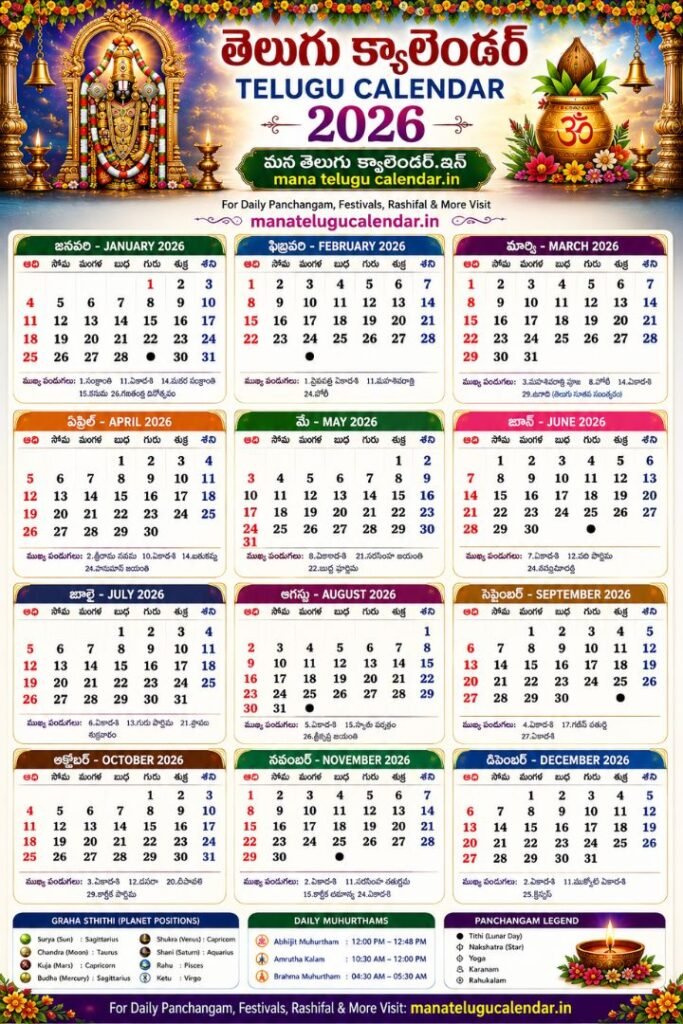
Telugu Calendar 2026 PDF Download (తెలుగు క్యాలెండర్ 2026)
You can now obtain the full-year 2026 Telugu Calendar in a single PDF file for easy download. We also offer month-wise updates whenever needed. In case any revisions or corrections are required for the Telugu Calendar 2026, this page will be promptly refreshed to reflect accurate information.
The Five Elements (Panchanga) Behind Every Date
Every date on this page is calculated using the five traditional elements that give the Panchangam its name:
- Tithi – the lunar day, based on the angle between the sun and moon
- Vara – the day of the week
- Nakshatra – the constellation the moon occupies
- Yoga – a combined solar-lunar calculation used to judge auspiciousness
- Karana – half of a tithi, used for finer muhurat calculations
Together, these five elements decide whether a particular day is favourable for a wedding, a Griha Pravesh, starting a new business, or simply beginning a fast. This is also why two Panchangams published a day apart can occasionally show a festival shifting by 24 hours — the tithi may end just before or just after sunrise in a particular city, which changes which Gregorian day the observance is counted on.
Telugu New Year 2026 – Ugadi (ఉగాది)
Ugadi 2026 falls on Thursday, March 19, marking the first day of Chaitra Masam and the start of Vishwavasu Nama Samvatsara. For Telugu households, this is the single most important day on the calendar, comparable to how the same tithi is celebrated as Gudi Padwa in Maharashtra or Cheti Chand among Sindhi communities, just under different regional names.
The day begins with an oil bath and home cleaning, followed by mango-leaf toranam on doorways and fresh muggu at the entrance. The centerpiece is Ugadi Pachadi, a dish that deliberately combines six flavours — jaggery for sweetness, raw mango for sourness, neem flowers for bitterness, tamarind for tang, salt, and green chili for heat — as a reminder that the coming year, like life itself, brings a mix of joy, sorrow, and everything in between.
Many families also gather for Panchanga Sravanam, a priest’s reading of the new year’s Panchangam, along with Rasi Phalalu, predictions for each zodiac sign. In several towns, Ugadi is also marked by Kavi Sammelanam, a gathering of poets who recite new verses to welcome the year, a tradition that has continued in Andhra Pradesh and Telangana for generations.
Telugu Festivals 2026 – Month-by-Month
| Month | Date | Festival / Event |
|---|---|---|
| January | 13 | Bhogi |
| January | 14 | Makara Sankranti (Pedda Panduga) |
| January | 15 | Kanuma |
| January | 16 | Mukkanuma |
| January | 26 | Republic Day |
| February | 15 | Maha Shivaratri |
| March | 3 | Holika Dahan |
| March | 4 | Holi (Rangwali Holi) |
| March | 19 | Ugadi (Telugu New Year) |
| March | 27 | Sri Rama Navami |
| April | 2 | Hanuman Jayanti |
| April | 14 | Dr. B. R. Ambedkar Jayanti |
| April | 20 | Akshaya Tritiya |
| May | 1 | May Day |
| May | 17 | Adhik Maas begins |
| June | 15 | Adhik Maas ends |
| July | 19 | Bonalu begins (Golconda) |
| July | 26 | Bonalu, second Sunday (Secunderabad) |
| July | 29 | Guru Purnima |
| August | 2 | Bonalu, third Sunday (Lal Darwaza) |
| August | 9 | Bonalu, final Sunday |
| August | 10 | Bonalu concludes (Telangana holiday) |
| August | 15 | Independence Day |
| August | 28 | Raksha Bandhan |
| September | 3 | Krishna Janmashtami (Smarta) |
| September | 4 | Krishna Janmashtami (Vaishnava/ISKCON) |
| September | 14 | Ganesh Chaturthi (Vinayaka Chavithi) |
| September | 14–23 | Salakatla Brahmotsavam, Tirumala |
| September | 24 | Ganesh Visarjan (Anant Chaturdashi) |
| October | 2 | Gandhi Jayanti |
| October | 11 | Navratri / Bathukamma begins |
| October | 11–20 | Navaratri Brahmotsavam, Tirumala |
| October | 19 | Saddula Bathukamma (main day) |
| October | 20 | Dussehra (Vijayadashami) |
| October | 25 | Sharad Purnima |
| October | 28 | Atla Tadde |
| October | 29 | Karwa Chauth |
| November | 6 | Dhanteras |
| November | 8 | Deepavali (Diwali) |
| November | 10 | Govardhan Puja |
| November | 20 | Devutthana Ekadashi (Chaturmas ends) |
| November | 24 | Kartik Purnima / Guru Nanak Jayanti |
| December | 25 | Christmas |
Ekadashi Vratam Dates 2026
2026 has 26 Ekadashi vratam instead of the usual 24, because Adhik Maas adds one extra Ekadashi in each of its two fortnights.
| Date | Ekadashi Name |
|---|---|
| January 8 | Pausha Putrada Ekadashi |
| January 29 | Jaya Ekadashi |
| February 13 | Vijaya Ekadashi |
| February 27 | Amalaki Ekadashi |
| March 14 | Papamochani Ekadashi |
| March 28 | Kamada Ekadashi |
| April 13 | Varuthini Ekadashi |
| April 27 | Mohini Ekadashi |
| May 13 | Apara Ekadashi |
| May 27 | Padmini Ekadashi (Adhik Maas) |
| June 11 | Parama Ekadashi (Adhik Maas) |
| June 25 | Nirjala Ekadashi |
| July 10 | Yogini Ekadashi |
| July 25 | Devshayani Ekadashi (Chaturmas begins) |
| August 8 | Kamika Ekadashi |
| August 23 | Shravana Putrada Ekadashi |
| September 7 | Aja Ekadashi |
| September 21 | Parivartini Ekadashi |
| October 6 | Indira Ekadashi |
| October 21 | Papankusha Ekadashi |
| November 4 | Rama Ekadashi |
| November 20 | Devutthana Ekadashi (Chaturmas ends) |
| December 4 | Utpanna Ekadashi |
| December 19 | Mokshada Ekadashi (Gita Jayanti) |
Sankashti Chaturthi (the monthly Ganesha vratam) and Pradosh Vratam (observed twice a month) fall separately — exact dates for those will be covered in our monthly Telugu Calendar articles.
Marriage Muhurat Dates 2026
| Month | Auspicious Dates |
|---|---|
| January | 1, 7, 10, 15, 23, 24, 25, 26 |
| February | 4, 5, 6, 8, 10, 12, 14, 19, 20, 21, 24, 25, 26 |
| March | 2, 3, 4, 7, 8, 9, 11, 12 |
| April | 15, 20, 21, 25, 26, 27, 28, 29 |
| May | 1, 3, 5, 6, 7, 8, 13, 14 |
| June | 21, 22, 23, 24, 25, 26, 27, 29 |
| July | 9, 10 |
| August | No shubh muhurat (Chaturmas) |
| September | No shubh muhurat (Chaturmas) |
| October | No shubh muhurat (Chaturmas) |
| November | 14, 15, 19, 20, 26 |
| December | 2, 3, 9, 10, 11 |
Chaturmas — the period when Lord Vishnu is traditionally considered to be in yogic rest — runs from Devshayani Ekadashi (July 25) to Devutthana Ekadashi (November 20) in 2026, which is why almost no marriage muhurats fall between late July and mid-November. Muhurat selection also depends on Nakshatra, Tara Bala, and planetary combustion, so always confirm the final date with a family astrologer or purohit before booking a venue.
Public Holidays 2026 – Andhra Pradesh & Telangana
| Date | Public Holiday |
|---|---|
| January 14 | Makara Sankranti |
| January 26 | Republic Day |
| March 19 | Ugadi |
| April 14 | Dr. B. R. Ambedkar Jayanti |
| May 1 | May Day |
| August 10 | Bonalu (Telangana only) |
| August 15 | Independence Day |
| September 14 | Ganesh Chaturthi |
| October 2 | Gandhi Jayanti |
| October 11 | Bathukamma Starting Day (Telangana only) |
| October 20 | Dussehra |
| November 8 | Deepavali |
| December 25 | Christmas |
This covers festivals typically declared as gazetted or restricted holidays. The final bank and optional holiday list is notified separately by each state government and the RBI — check the official AP or Telangana gazette closer to each date for confirmation in your district.
Regional Telugu Festivals You Shouldn’t Miss
Sankranti in Andhra Pradesh
Makara Sankranti is really a four-day celebration in Andhra Pradesh, not a single day. Bhogi opens the festival with a bonfire made of old wood and household items lit before sunrise, symbolizing letting go of the old year. Children also receive Bhogi Pallu — a shower of regi pandlu (jujube fruit), flowers, and coins poured over their heads for good health. The main day, Pedda Panduga, is spent with family, decorated with elaborate muggu on freshly cow-dung-washed courtyards, gangireddu (decorated bull) performances going door to door, and Haridasu processions singing devotional songs with a brass pot balanced on the head. Kanuma honours cattle and farm animals, with many rural households performing a small puja for their bullocks, while Mukkanuma, observed mainly in coastal Andhra districts like East and West Godavari, closes the four-day festivities.
Bonalu – Telangana’s Festival of the Mother Goddess
Bonalu 2026 falls on four consecutive Sundays in Ashadha Masam — July 19, 26, August 2, and 9 — with the Telangana government marking August 10 as a public holiday to close the season. The ritual centres on the Bonam, a brass or earthen pot of rice cooked with jaggery and curd, decorated with turmeric and neem leaves, carried on the head by women to the goddess’s temple.
The celebrations move through the city in sequence: Golconda Fort’s Sri Jagadamba temple opens the season on the first Sunday, followed by Secunderabad’s Ujjaini Mahankali temple, where the Rangam oracle ritual takes place — a woman devotee enters a trance believed to channel the goddess and delivers predictions for the year ahead. Lal Darwaza in the Old City hosts the closing celebrations with the energetic Pothuraju procession, where a man painted in turmeric leads devotees through the streets cracking a whip to drive away negative energy. The Telangana government declared Bonalu an official state festival in 2014, recognising it alongside Bathukamma as one of the clearest markers of Telangana’s cultural identity.
Bathukamma – Telangana’s Flower Festival
Bathukamma 2026 runs for nine days from October 11, coinciding with Sharad Navratri, and closes with Saddula Bathukamma on October 19, two days before Dussehra. Women and girls arrange seasonal, medicinal flowers — including Tangedu (Senna), Gunuka (Celosia), and Banti (Marigold) — in seven concentric layers shaped like a temple gopuram, topped with a small turmeric idol of Goddess Gauramma. Each evening, women gather in their neighbourhood to sing traditional Bathukamma songs and circle the arrangement.
Every day of the festival carries its own name and food offering, moving from simple sesame and jaggery on the first day to five varieties of rice, including curd rice and tamarind rice, on the final day. On Saddula Bathukamma, the flower stacks are carried in procession to a nearby lake or pond and immersed in the water — a fittingly eco-friendly close to a festival that celebrates nature itself, since every material used is biodegradable.
Tirumala Brahmotsavam 2026 – A Rare Double Celebration
Because of this year’s Adhik Maas, Tirumala celebrates Brahmotsavam twice — a genuinely rare occurrence for pilgrims. The Salakatla (annual) Brahmotsavam runs roughly September 14–23 and opens with the Dwajarohanam flag-hoisting ceremony, while the Navaratri Brahmotsavam follows roughly October 11–20 and opens instead with the Golden Tirucchi Utsavam, since the flag is not hoisted twice in the same year.
Garuda Seva, when Lord Venkateswara is carried on the divine eagle vahana, is the single most crowded and spiritually significant day of any Brahmotsavam, typically falling on the fifth day of each festival — darshan on this day is believed in Vaishnava tradition to be equivalent to attaining moksha. Other highlights across both festivals include Rathotsavam, the grand chariot procession, and Chakrasnanam, the concluding holy bath of the utsava idols. Exact TTD-confirmed dates can shift slightly as the temple finalises its Panchangam, so check tirumala.org closer to the date if you’re planning a visit, and book darshan and accommodation early since both festival windows draw exceptionally large crowds.
Frequently Asked Questions
Q1: What is the Telugu Calendar 2026 based on? It follows the traditional Amanta lunisolar Panchangam used across Andhra Pradesh and Telangana, tracking Shaka Samvat 1947–1948 and the Parabhava Nama Samvatsaram, which begins at Ugadi on March 19, 2026.
Q2: When exactly is Ugadi in 2026? Ugadi falls on Thursday, March 19, 2026, marking the start of the Telugu New Year and the Parabhava Samvatsaram.
Q3: Why do some sites list Makar Sankranti as January 14 and others as January 15? January 14 is when the Sun astronomically enters Capricorn. Because this happens after sunrise, Telugu tradition observes the main Sankranti rituals the next day, January 15 — both dates are correct depending on what you’re asking.
Q4: What is Adhik Maas, and how does it affect the 2026 calendar? Adhik Maas is an extra lunar month added roughly every 32–33 months to keep the lunar calendar aligned with the solar year. In 2026, it runs from May 17 to June 15 as Adhik Jyeshtha Maas, and it’s considered a strong period for fasting and worship, but not for weddings or new ventures.
Q5: Why is there no marriage muhurat between August and October 2026? This period falls within Chaturmas and Pitru Paksha, both traditionally treated as unsuitable for weddings and other auspicious new beginnings. The muhurat calendar picks back up in mid-November.
Q6: How is an Ekadashi date decided, and why might it differ by a day on different sites? Ekadashi is the 11th tithi of each lunar fortnight, calculated from local sunrise. Because Smarta and Vaishnava traditions sometimes round the tithi differently, the same Ekadashi can occasionally appear a day apart on different Panchangams — neither is “wrong,” they’re just following different conventions.
Q7: Are these dates the same across all Telugu-speaking regions? The festival dates themselves are consistent, since they come from the same Panchangam. What can shift slightly by city is the exact puja muhurat timing, because that depends on local sunrise.
Q8: Can I get a printable version of this calendar? You can save or print this page directly from your browser for offline reference. If your site publishes a dedicated monthly calendar image or PDF, that’s a natural addition to link from the month-by-month table above.
Conclusion
Between Sankranti in January and Christmas in December, 2026 is a busy year on the Telugu calendar — made a little busier by an extra Adhik Maas month sitting right in the middle of it. Whether you’re planning festival travel, fixing a wedding date, or just keeping track of your next Ekadashi fast, bookmark this page and come back whenever you need a quick check. We review and correct these dates as needed, so treat this as a living reference rather than a one-time download.